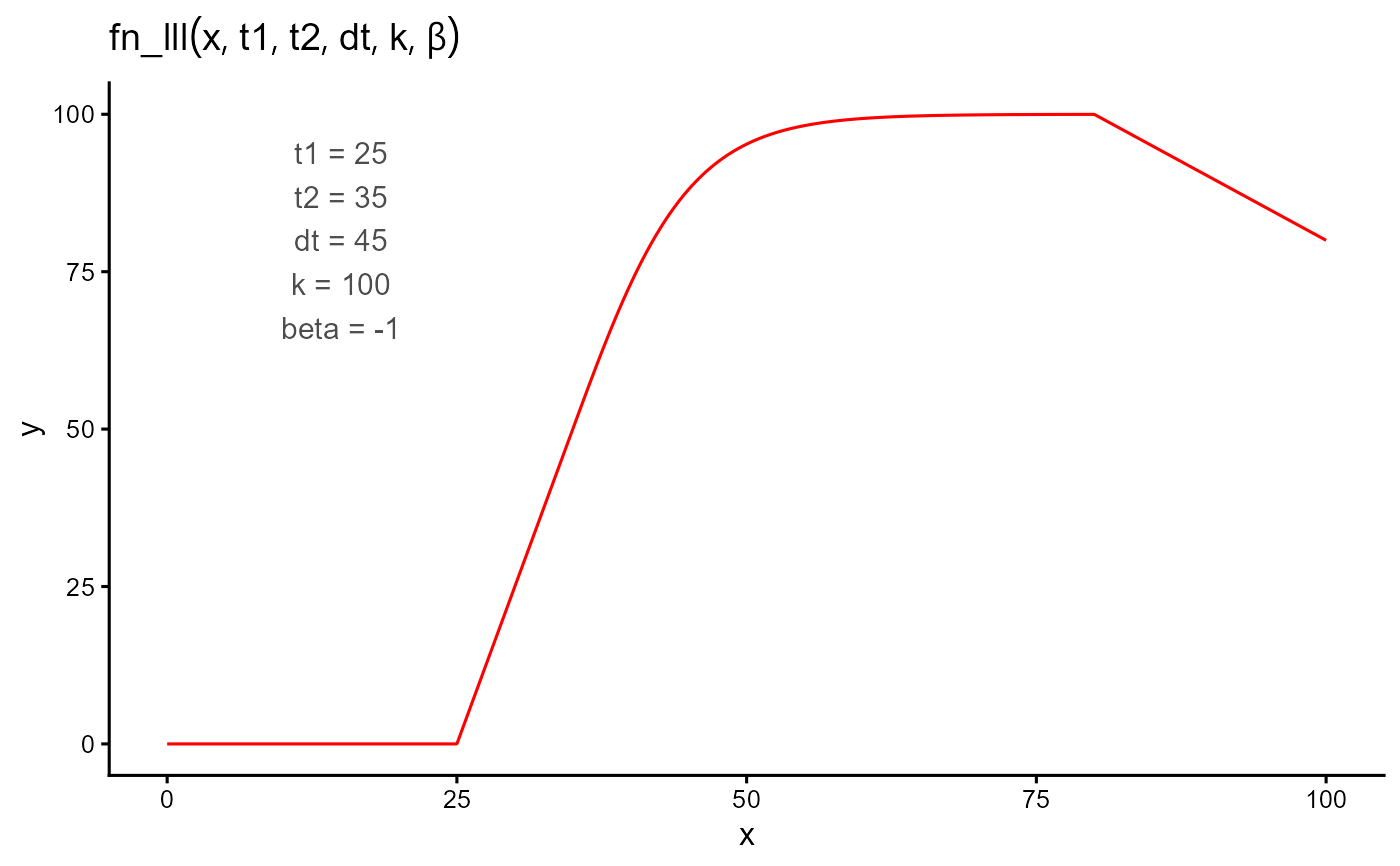
A piecewise function that models (i) an initial linear increase from zero, (ii) a smooth logistic rise toward an upper asymptote, and (iii) a final linear phase.
Arguments
- t
A numeric vector of input values (e.g., time).
- t1
The onset time of the response. The function is 0 for all values less than or equal to
t1.- t2
The time when the initial linear phase ends and the logistic phase begins. Must be greater than
t1.- dt
Duration of the logistic phase. Defines
t3 = t2 + dtand must be positive.- k
Upper asymptote (maximum level) of the logistic component.
- beta
Slope of the final linear phase after
t3(often negative).
Details
$$ f(t; t_1, t_2, dt, k, \beta) = \begin{cases} 0 & \text{if } t \le t_1 \\ \dfrac{k/2}{t_2 - t_1}\,(t - t_1) & \text{if } t_1 < t \le t_2 \\ \dfrac{k}{1 + \exp\left(-2\,\dfrac{t - t_2}{t_2 - t_1}\right)} & \text{if } t_2 < t \le t_3 \\ \dfrac{k}{1 + \exp\left(-2\,\dfrac{t_3 - t_2}{t_2 - t_1}\right)} + \beta\,(t - t_3) & \text{if } t > t_3 \end{cases} $$
where \(t_3 = t_2 + dt\).
The function is continuous at t1, t2, and t3. It is
differentiable at t2 by construction (the linear slope matches the
logistic derivative at t2). It is not differentiable at t1, and
it is generally not differentiable at t3 unless beta matches
the logistic derivative at t3.